Author

Danny White

Browsing

When you invest in precision engineering, your Porsche service centre becomes more than just a maintenance stop—it transforms into the guardian of your automotive dreams. In an industry where customer expectations have shifted dramatically, traditional car servicing has evolved into a concierge experience where every interaction reflects the same meticulous attention to detail that went into crafting your vehicle.

The story unfolding across service workshops worldwide represents a fundamental reimagining of automotive care in 2025, where technology meets craftsmanship.

The New Standard of Excellence

Recent industry recognition has illuminated how dramatically the service landscape has transformed. Porsche’s achievement of the number one ranking in the J.D. Power 2025 Customer Service Index Study wasn’t merely statistical—it represented a comprehensive reimagining of premium automotive service. The study, encompassing over 55,000 respondents, revealed that service excellence has become as crucial as vehicle engineering.

The achievement reflects across every service touchpoint. The evaluation covered five critical areas: Service Advisor interaction, Service Facility quality, Service Initiation process, Service Quality delivery, and Vehicle Pick-Up experience. Each represents a moment where trust is either built or eroded.

“We understand that bringing your vehicle to us isn’t just about maintenance—it’s about preserving the relationship you have with your car,” explains a senior service consultant at a leading automotive service facility in Singapore. “Every conversation, every diagnosis, every repair is an opportunity to reinforce why you chose this brand in the first place.”

Technology Meets Traditional Craftsmanship

The modern Porsche workshop represents a fascinating convergence of cutting-edge diagnostics and time-honoured mechanical expertise. Advanced facilities now feature state-of-the-art infrastructure specifically designed for both traditional combustion engines and the growing fleet of battery-electric vehicles, complete with high-power charging capabilities and specialised technician training.

Consider the transformation happening in service centres across the region:

  • Diagnostic precision: Modern workshops utilise the same diagnostic equipment found in factory facilities, ensuring that every sensor reading, every system check, and every performance metric meets exact manufacturer specifications

  • Specialised expertise: Technicians now undergo extensive certification in high-voltage systems, with dedicated teams of specialists trained specifically for electric vehicle maintenance

  • Environmental responsibility: New service facilities incorporate energy-efficient infrastructure and eco-friendly practices, reflecting a broader commitment to sustainability that extends beyond the vehicles themselves

  • Capacity expansion: Leading service centres can now handle over 90 vehicles per day, with plans for further expansion to meet growing demand

The integration of smart technology into service operations has revolutionised how maintenance schedules are managed and how potential issues are identified before they become problems. This proactive approach transforms the service experience from reactive maintenance to predictive care.

The Singapore Revolution

Singapore’s emergence as a regional hub for premium automotive service reflects broader trends in luxury automotive care. The upcoming Porsche Experience Centre Singapore, set to open in 2027, represents a 90,000 square metre facility that will feature dynamic circuits, comprehensive service facilities, and immersive brand experiences. This development signals a shift towards service centres that function as destinations rather than mere pit stops.

The transformation extends beyond traditional boundaries. New concepts like ‘Porsche at Jewel’, scheduled to open in 2025 at Changi Airport, will feature rotating car displays and could potentially function as service drop-off and pick-up points for owners travelling internationally. Such innovations demonstrate how service provision is expanding to accommodate the increasingly mobile lifestyles of premium vehicle owners.

Understanding the True Cost of Excellence

The reality of premium vehicle ownership includes acknowledging the investment required for proper maintenance. Industry analysis indicates that Porsche maintenance costs can reach $22,075 over ten years, positioning it among the higher-maintenance luxury brands. However, this figure tells only part of the story.

The value proposition extends beyond mere cost considerations. With a brand loyalty rate of 57.4% among premium car brands, Porsche owners demonstrate a remarkable commitment to the brand experience. This loyalty reflects not just satisfaction with the vehicles themselves, but appreciation for the comprehensive ownership experience that begins the moment you enter a service facility.

Modern service centres now offer various programmes designed to make premium maintenance more accessible:

  • Prepaid maintenance plans: Structured programmes that hedge against inflation whilst ensuring consistent care standards

  • Subscription services: Innovative approaches that bundle maintenance, insurance, and vehicle access into comprehensive packages

  • Transparent pricing: Clear communication about service costs and timeframes, eliminating the uncertainty that previously characterised automotive service

The Human Element in High-Tech Service

Despite technological advances, the most successful service centres recognise that premium automotive service remains fundamentally about human relationships. The difference between adequate service and exceptional care often lies in the expertise and dedication of individual technicians and service advisors who understand that they’re not just maintaining machines—they’re preserving the dreams and aspirations that those machines represent.

This human element becomes particularly important when considering the emotional attachment many owners develop with their vehicles. A skilled service advisor doesn’t simply diagnose problems; they translate technical complexities into understandable language, provide realistic timelines, and ensure that every interaction reinforces the premium nature of the ownership experience.

The evolution of automotive service reflects broader changes in consumer expectations and technological capabilities. As vehicles become more sophisticated and owners more discerning, the service experience must evolve to match. The most successful facilities recognise that excellence in automotive service isn’t just about technical competence—it’s about creating an experience worthy of the investment owners have made in their vehicles.

In this landscape of elevated expectations and technological innovation, choosing the right automotive service provider becomes as important as selecting the vehicle itself, ensuring that your automotive investment receives the attention and expertise it deserves through a genuinely exceptional Porsche service centre.


When your dashboard’s check engine light comes on, it can be scary.  It’s common for fixes or delays to go wrong when you try to guess the cause on your own.  Professional diagnostic testing makes it easy to read engine codes with the right tools and trained hands.  It finds the exact problems, keeps things from going to waste, and gives clear steps for fixing them.  This way gives you confidence, saves you money in the long run, and makes every drive safer.

Expert tools make sure accurate results

  • Newest tools for scanning
  • Accurate reads of codes
  • Correct fault finding

These bays have tools that can connect to your car’s computer.  These tools quickly read all the codes.  You are given a full list of engine problems.  This makes it easier for the tech to find problems quickly.  You no longer have to guess or switch parts one by one.

Detailed Data Brings  More Insights

  • Full lists of errors
  • Readout of live show
  • History of mistakes made in the past

Pros: They do more than just punch in codes.  They keep an eye on real-time info to see how your engine works.  They write down hints like how much fuel is used and the speed at which the engine is not moving.  Hidden problems can be seen in this whole picture.  You protect your car’s health and avoid quick fixes that don’t work in the long run.

Fixes More Often  Encourage people to save money

  • Quick checks for errors
  • Less time spent working
  • Not as much waste

Coders read the codes to quickly find the cause.  Long fixes that cost more are avoided.  When you have clear results, you only buy the things you need and plan for the right time.  This cuts down on service costs and house calls.  It’s better for your cash.

Reports You Can Trust  Cut down  Repairs over and over

  • Full history of faults
  • Logs of official results
  • Tests that are always the same

The check engine light warning is linked to exact numbers by experts, which saves time.  For future use, they keep records of each check.  By showing past fixes, this record stops changes from being done again.  Long-term dependability is gained, and steps that waste time and money are skipped.

You can drive with peace of mind, save money, and keep your car safe by taking this route.  When you pay for professional diagnostics, there are fewer shocks and the repair process goes more smoothly every time.  Accept skilled testing, and then you can drive without worrying.

Behind Singapore’s gleaming façade of efficient urban planning lies a little-understood industry that processes thousands of vehicles annually, yet Scrap Car Singapore operations remain largely invisible to the very people who depend on them most. Every month, roughly 4,000 vehicles reach the end of their regulated lifespan in Singapore, creating a complex ecosystem of recycling, regulation, and remarkable economics that most car owners discover only when facing their own automotive crossroads.

The Numbers That Tell the Real Story

Walk through any of Singapore’s authorised scrap car facilities, and the scale becomes immediately apparent. Mountains of salvaged steel rise like metallic hills, whilst precision machinery sorts copper wiring with surgical accuracy. The statistics reveal an industry processing approximately 48,000 vehicles annually—each one representing a family’s transportation solution that has reached its regulatory endpoint.

The financial flows prove equally impressive. Industry data suggests that Singapore’s automotive recycling sector processes materials worth tens of millions of dollars each year, yet individual vehicle owners often capture only a fraction of this value due to information asymmetries and processing inefficiencies.

These facilities operate with industrial precision that would impress any manufacturing engineer. Advanced hydraulic systems can process a complete vehicle in under two hours, separating materials with efficiency rates exceeding 90%. The contrast between this industrial capability and the confusion experienced by individual car owners reveals a significant knowledge gap.

Inside the Machine: How Your Car Becomes Cash

The transformation process begins the moment a vehicle enters an authorised facility. Trained technicians conduct systematic fluid drainage of engine oil, transmission fluid, brake fluid, and coolant, each requiring specific handling protocols to meet environmental standards. This preliminary step alone can take 45 minutes for a typical sedan.

Next comes the methodical dismantling phase:

  • Battery removal: Lead-acid batteries command immediate resale value
  • Catalytic converter extraction: Contains precious metals worth hundreds of dollars
  • Tyre assessment: Serviceable tyres often find secondary markets
  • Electronic component recovery: Modern vehicles contain surprising amounts of recoverable technology
  • Engine block separation: Cast iron and aluminium components enter different processing streams

The precision required becomes evident when observing technicians work. A single mistake in fluid handling can contaminate entire material batches, whilst improper dismantling can damage valuable components beyond recovery.

The Human Stories Behind the Statistics

Meet Sarah Tan, a 34-year-old marketing executive whose Honda reached its COE expiry last month. Like many Singaporeans, she initially considered the scrapping process a bureaucratic nightmare. “I expected weeks of paperwork and minimal returns,” she recalls. “Instead, the entire process took three days, and I received enough to cover the deposit on my next vehicle.”

Her experience illustrates how individual expectations often diverge from reality. The gap between perception and actuality creates opportunities for those who understand the system whilst disadvantaging those who don’t.

The Regulatory Framework That Changes Everything

Singapore’s Certificate of Entitlement system creates unique dynamics absent in other automotive markets. Unlike countries where vehicles might operate for decades, Singapore’s regulatory environment ensures predictable disposal timelines that enable more efficient processing systems.

The Land Transport Authority maintains strict oversight of the entire process, requiring detailed documentation at each stage. This regulatory framework protects consumers whilst ensuring environmental compliance, but it also creates complexity that intimidates uninformed vehicle owners.

Understanding these regulations proves crucial for maximising outcomes. Vehicle owners who approach disposal with proper knowledge consistently achieve better results than those who stumble through the process uninformed.

The Environmental Imperative Driving Innovation

Singapore’s commitment to environmental sustainability has transformed automotive recycling from basic scrap processing into sophisticated material recovery operations. Modern facilities recover everything from rare earth elements in electronic systems to specialised plastics used in interior components.

As one industry veteran explains: “Twenty years ago, we were essentially scrap dealers who happened to work with cars. Today, we’re materials recovery specialists who understand the molecular composition of every component. The technology and expertise required have increased exponentially, but so has our ability to extract value from every vehicle.”

This evolution reflects Singapore’s broader commitment to circular economy principles. What once represented waste disposal has become resource recovery, creating value streams that benefit both individual vehicle owners and society broadly.

The Technology Revolution Transforming Operations

Sophisticated sorting systems now identify and separate materials with precision that was impossible just a decade ago. Optical recognition technology can distinguish between different grades of plastic, whilst magnetic separation systems recover ferrous materials with near-perfect efficiency.

These technological advances translate directly into improved outcomes for vehicle owners. More efficient processing means higher recovery rates, which ultimately supports better payouts for end-of-life vehicles.

The Decision Matrix: Timing Your Move

Market conditions significantly influence final outcomes, with factors including global commodity prices, seasonal demand patterns, and regulatory changes all affecting values. Vehicle owners who understand these dynamics can time their disposal decisions to capture optimal returns.

The key lies in recognising that vehicle disposal represents a market transaction subject to the same economic forces that affect other commodity trades. Strategic timing, proper preparation, and professional guidance can significantly impact final outcomes.

Your vehicle’s end-of-life transition doesn’t have to be a source of stress or financial disappointment when you understand how to navigate the sophisticated systems that comprise Scrap Car Singapore operations.

The evolution of the minibus Singapore has witnessed over the past five decades offers a compelling lens through which to examine the broader transformation of Southeast Asian urban mobility and the complex relationship between state planning and social adaptation. From the chaotic entrepreneurial fervour of the 1970s to today’s regulated and increasingly sophisticated transport ecosystem, the minibus serves as both artifact and agent of Singapore’s metamorphosis from colonial port to global city-state.

Historical Foundations: The Colonial Legacy and Post-Independence Innovation

To understand Singapore’s contemporary minibus landscape, one must first appreciate the historical context that shaped its emergence. The island’s transport infrastructure inherited from British colonial rule was designed primarily to facilitate the movement of goods and colonial administrators, not the diverse mobility needs of an independent, rapidly urbanising population.

The minibus phenomenon that emerged in the 1970s represented a grassroots response to this infrastructural gap. Local entrepreneurs, many of them recent immigrants or working-class Singaporeans, recognised an opportunity to serve communities inadequately connected by existing bus routes. This period of relative regulatory laissez-faire allowed for experimentation that would later inform official transport policy.

The parallel with other post-colonial societies is instructive. Just as shared taxis evolved in South Africa or jeepneys proliferated in the Philippines, Singapore’s early minibus culture reflected the universal tension between formal planning and informal innovation that characterises urban development in newly independent states.

Regulatory Evolution and the Discipline of Urban Planning

Singapore’s approach to minibus regulation reveals the distinctive characteristics of its developmental state model. Unlike cities where informal transport operates in perpetual tension with authority, Singapore chose to incorporate and systematise rather than suppress.

The government’s strategy involved several key elements:

•       Licensing systems that professionalised drivers whilst maintaining service flexibility

•       Route coordination to complement rather than compete with mass transit

•       Safety standards that elevated operational quality without stifling innovation

•       Integration with broader transport planning that recognised minibuses as essential infrastructure

•       Economic frameworks that balanced entrepreneurship with public service obligations

This regulatory approach reflects what urban planning scholars term “adaptive governance”—the capacity to harness market innovation whilst directing it towards collective goals. The Singapore model demonstrates how small-scale transport can be neither purely commercial nor entirely state-controlled, but rather occupy a carefully managed middle ground.

Social Dynamics and Community Connectivity

The social significance of minibuses extends far beyond mere transportation logistics. In Singapore’s ethnically diverse society, minibuses often serve as informal spaces of cultural exchange, where residents from different backgrounds share brief but meaningful encounters during their daily journeys.

Observational studies reveal how minibus routes frequently serve as lifelines for elderly residents in housing estates, providing door-to-door connectivity that larger buses cannot offer. The flexibility to accommodate wheelchairs, shopping trolleys, and other personal effects makes minibuses particularly valuable for populations with specific mobility requirements.

The drivers themselves often become integral figures in neighbourhood life, developing relationships with regular passengers that extend beyond mere service provision. This social dimension recalls the role of streetcar conductors in early twentieth-century American cities or bus drivers in post-war British communities—transport workers who served as informal community facilitators.

Economic Implications and Labour Market Dynamics

The minibus sector’s economic impact illuminates broader patterns in Singapore’s labour market evolution. For many drivers, minibus operation represents a pathway to small-scale entrepreneurship that requires relatively modest capital investment compared to other business ventures.

As transport economist Dr. Elena Marchetti observes, “Singapore’s minibus sector demonstrates how thoughtful regulation can preserve the entrepreneurial spirit of informal transport whilst ensuring service quality and safety standards. It’s a model that balances individual economic opportunity with collective urban mobility needs.”

The sector also provides employment flexibility particularly valued by older workers and those seeking to supplement primary incomes. This economic function becomes increasingly important as Singapore, like other developed economies, grapples with demographic transitions and changing labour market expectations.

Technological Integration and Future Adaptations

Contemporary developments in Singapore’s minibus sector reflect broader trends towards technological integration in urban transport. Digital booking platforms, real-time tracking systems, and electronic payment methods have modernised operations whilst preserving the personal scale that distinguishes minibuses from mass transit.

The integration of environmental considerations—through hybrid engines and route optimisation—demonstrates how traditional transport modes can adapt to contemporary sustainability imperatives. This evolution parallels broader patterns in urban policy where established systems incorporate new technologies rather than being replaced by them.

Comparative Perspectives and Global Lessons

Singapore’s minibus experience offers valuable insights for other cities seeking to balance transport efficiency with social equity. The success of regulatory integration suggests that informal transport need not be viewed as a problem to be solved but rather as a resource to be optimised.

Cities from Cape Town to Manila face similar challenges in incorporating small-scale transport into formal planning frameworks. Singapore’s approach—emphasising coordination rather than competition, quality rather than quantity—provides a potential model for reconciling entrepreneurial transport provision with systematic urban planning.

The minibus Singapore continues to evolve today represents more than a transport mode; it embodies a distinctive approach to urban governance that values both efficiency and human scale, both innovation and regulation, both individual enterprise and collective welfare.

Introduction: Why the Electric Car Landscape is Buzzing in Singapore

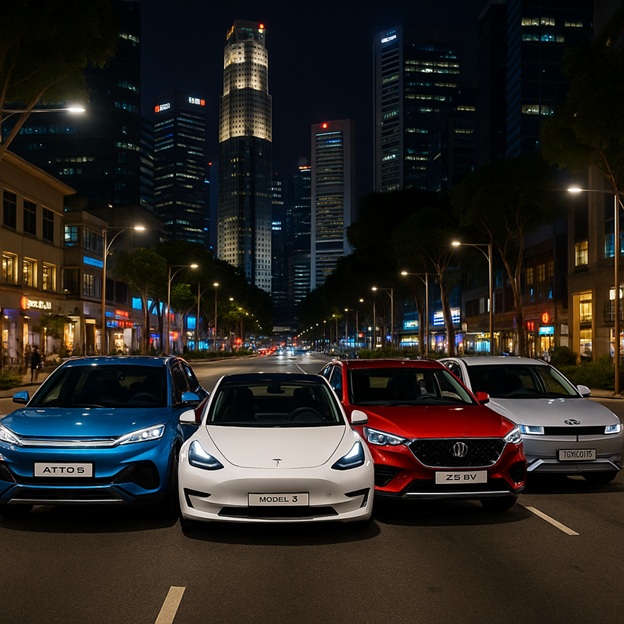
Singapore’s roads are changing fast. More drivers are switching to electric vehicles (EVs) as eco-friendliness, rising petrol prices, and government incentives make internal combustion cars look old-fashioned. But with so many options from BYD’s versatile line-up to Tesla’s tech-heavy models, MG’s budget-friendly choices and Hyundai’s futuristic designs – how do you know which EV really fits your lifestyle and wallet?

At Jack Cars, we understand that buying your first or next electric car isn’t just about specs and sticker price. It’s about matching your needs for daily commuting, space for family trips, or a touch of luxury, all while keeping running costs predictable. Below, we dig into how BYD stacks up against Tesla, MG, and Hyundai so you can decide confidently.

Most Popular Electric Car Brands in Singapore Right Now

BYD has quickly carved out a reputation as an affordable yet cutting-edge choice. Models like BYD Atto 3, Dolphin, Seal, and the practical e6 taxi are increasingly spotted around town.

Tesla remains dominant among those who love technology and recognisable branding, with the Model 3 and Model Y leading its charge.

MG appeals to buyers looking for value-for-money, offering the MG ZS EV and MG 4. Hyundai’s Kona Electric and the retro-inspired Ioniq 5 bring Korean build quality and established service networks into play. Optional models like the Kia EV6 and Nissan Leaf expand consumer choices further, especially amongst savvy urbanites searching “BYD car Singapore” or “explore the latest BYD electric vehicles in Singapore.

How Upfront Costs Compare: Where Does BYD Stand?

  • BYD Atto 3: $160k–$180k (including COE)
  • Tesla Model 3: $200k–$220k (including COE)
  • MG ZS EV: $165k–$185k (including COE)
  • Hyundai Ioniq 5: $215k–$235k (including COE)

These figures fluctuate with market movement and promo cycles. MG and BYD are the most budget-friendly, while Tesla still rides high on prestige pricing. Included in most packages: charging cable, warranty, and sometimes servicing credits. BYD often offers longer warranties as part of Jack Cars’ value proposition.

Quick snapshot:

  • BYD = Top marks for affordability and value-added inclusions.
  • Tesla = Premium price for premium brand cachet.
  • MG = Affordable entry point for new EV owners.
  • Hyundai = Competitive, but typically priciest among mainstream options.

Battery Range & Charging: Perfect for City Living?

  • BYD Atto 3: About 420 km per charge
  • Tesla Model 3: About 438 km per charge
  • MG ZS EV: 320–440 km (model-dependent)
  • Hyundai Ioniq 5: Up to 481 km

All four brands cover Singapore’s most common driving patterns easily—think work commutes, school runs, island-wide adventures. Fast-charging capability and battery size also matter.

  • Tesla edges ahead slightly on universal Supercharger access and charging speeds.
  • Ioniq 5 supports ultra-fast 800V charging, reducing dwell time at stations.

For the value-conscious, BYD keeps pace impressively with practical range and robust battery reliability, especially with support from Jack Cars’ BYD-certified technical team.

Features & Tech: From Rotating Screens to Advanced Apps

Tech features are where tastes differ most:

  • BYD shines with its rotating infotainment screen, making navigation and entertainment user-friendly.
  • Tesla’s minimalist dashboard acts as one big control centre—impressive but takes getting used to.
  • MG and Hyundai come loaded with Apple CarPlay/Android Auto, though their UI designs feel more ‘traditional’.

Safety features such as adaptive cruise control, automatic braking, and multiple airbags are mandatory across all four. BYD models often stand out for ergonomic cabin layouts and thoughtful touches that turn routine drives into nice surprises.

Interior and Cabin Space: Which Is Best for Family Use?

Space is a top priority for families or those picking ride-share models like BYD e6. Here’s what stands out:

  • BYD Atto 3: Smart modular storage, flat floor for maximum rear passenger comfort
  • Tesla Model Y: Roomiest boot among the lot—great for weekend outings
  • MG ZS EV: Compact outside, but cleverly maximised inside
  • Hyundai Ioniq 5: Flexible seating and front-to-rear flat floor

Cabin design on newer BYD cars feels cheerier and less clinical than some rivals. If a child seat, stroller, or occasional haul is on your must-have list, BYD and Tesla score highest thanks to wider doors and adjustable boot layouts.

After-Sales Support: Why the Service Team Makes a Difference

Buying an EV means committing to both upfront cost and ongoing care. This is where Jack Cars pulls ahead with BYD:

  • Dedicated BYD-certified technicians at the Jack Cars Service Centre
  • Access to advanced diagnostics – minimising downtime and guesswork
  • Transparent, competitive servicing rates

In contrast, Tesla operates its own direct channels but appointments may be harder to secure during peak periods. Both MG and Hyundai have official dealer workshops, but don’t always offer personalisation or post-purchase engagement as extensive as Jack Cars’ Car Concierge Service.

Warranty coverage and genuine parts availability are vital. Jack Cars keeps key BYD components in stock, so BYD owners rarely face delays for repairs—a strong advantage for business fleets or ride-hailing.

Government Incentives: Who Gets the Biggest Rebates?

Every model reviewed here qualifies for the VES (Vehicular Emissions Scheme) rebate, and most receive the EEAI (Electric Vehicle Early Adoption Incentive). This brings actual drive-away prices down by thousands:

  • BYD Atto 3, Dolphin and Seal: Maximum rebates applied
  • Tesla Model 3/Y: Equally eligible, but higher OMV bumps road tax slightly
  • Hyundai and MG: Similar incentive structure

Overall annual road tax varies with power output. BYD models tend to sit in the middle bracket, so they’re easy on the recurring outflows for most households.

Brand Value & Local Market Presence: BYD’s Meteoric Rise

Tesla led early, boosted by its international reputation and cult following. However, BYD’s aggressive push – supported by local partners like Jack Cars – is making it more mainstream. Registration stats show increasing adoption of BYD, matched by positive feedback for reliability and running costs.

Hyundai maintains long-term trust with conservative buyers. MG blends UK heritage with Chinese engineering efficiency, appealing to younger professionals. Tesla buyers mostly favour the brand’s tech prestige.

Jack Cars reinforces BYD’s edge through:

  • Full range availability
  • Specialised aftercare teams
  • Education sessions for new EV adopters

Market trends and online motoring forums confirm: search volume for “byd car Singapore” and “explore the latest BYD electric vehicles in Singapore” is fast catching Tesla-related keywords.

What Should You Really Buy? Matching the Right EV to Your Needs

It comes down to priorities:

  • Urban commuters seeking affordability and straightforward servicing? Go for BYD.
  • Prestige-seekers keen on pure tech and a badge appeal? That’s Tesla territory.
  • Families wanting maximum safety and fuss-free interiors? Check Hyundai and BYD.
  • Cost-conscious first-time EV owners who want a simple, reliable solution? Shortlist MG and BYD.

Jack Cars’ transparent approach (accredited by CaseTrust-SVTA), wide vehicle selection, and unique service infrastructure make the leap to electric seamless and worry-free.

Summary: Why BYD is Grabbing Attention — And Could Be Right For You

Ultimately, BYD makes a compelling case for every day Singaporean drivers. With competitive pricing, modern tech, and dedicated after-sales support courtesy of Jack Cars, it’s no wonder they’re winning hearts from HDBs to Sentosa Cove. Whether you’re upsizing for a growing family, seeking to slash commuting emissions, or simply want a future-ready ride without hidden costs, putting a BYD on your shortlist is a very smart idea.

Ready to explore the latest BYD electric vehicles in Singapore? Book a test drive or speak with our EV experts today at Jack Cars – your trusted partner for a smooth, safe, and electrifying journey.

If informative, unbiased comparison and professional guidance matter to you, let Jack Cars help you make the smartest choice. See you on the greener side of driving!


Car tyres represent perhaps the most overlooked component of urban mobility, yet these humble rubber circles reveal surprising truths about who thrives and who merely survives on Singapore’s immaculate roadways. At the void deck of a Tampines HDB block, Mr. Lim, a 61-year-old private-hire driver, inspects his vehicle’s worn treads with visible concern. The replacement will consume nearly three days’ income—an expense he’s delayed twice already. Meanwhile, in a Dempsey Hill driveway, an investment banker casually mentions replacing his performance tyres “every other year, just to be safe,” a frequency determined not by wear but by calendar.

The Safety Tax: When Financial Precarity Becomes Physical Risk

The relationship between socioeconomic status and tyre quality creates an invisible safety gradient across Singapore’s roadways:

  • Budget tyres with reduced wet-weather performance predominate in neighbourhoods like Woodlands and Jurong
  • Mid-range options appear most frequently in middle-income areas like Bishan and Serangoon
  • Premium brands with advanced safety features cluster in Bukit Timah and River Valley
  • Ultra-performance tyres, often costing more than a month’s median salary, concentrate in exclusive enclaves

“What we’re seeing is effectively a safety premium,” explains a traffic safety researcher from Nanyang Technological University who studies accident patterns across income brackets. “Households under financial pressure often must choose between optimal safety margins and economic survival. The resulting compromises become particularly dangerous during monsoon season.”

The Maintenance Divide: When Knowledge Gaps Become Physical Gaps

Beyond initial purchase decisions, tyre maintenance practices reflect dramatic disparities in available resources:

1. Pressure Monitoring:

Upper-income drivers benefit from automated systems while lower-income motorists rely on visual inspection

2. Rotation Schedules:

Systematic rotation extends tyre life but requires deliberate planning and service relationships often unavailable to precarious workers

3. Alignment Service:

Regular alignment prevents uneven wear but represents a “luxury expense” for budget-constrained households

4. Storage Conditions:

Covered parking protects rubber compounds from UV degradation—a benefit unevenly distributed across housing types

“The typical tyre lifespan gap between similar vehicles in Toa Payoh versus those in Tanglin can exceed 30%,” notes a vocational instructor at ITE College West’s automotive programme. “This difference stems not from driving habits but from maintenance infrastructure.”

The Knowledge Economy: Information as Invisible Privilege

The information asymmetry surrounding tyre selection and maintenance creates yet another layer of disadvantage:

  • Understanding tyre date codes—essential in Singapore’s heat—requires specific knowledge rarely communicated to budget-focused consumers
  • Deciphering tyre ratings (load index, speed rating, temperature resistance) demands technical literacy
  • Evaluating wet-weather performance claims requires access to independent testing data
  • Calculating true cost-per-kilometre necessitates mathematical skills and record-keeping practices

“What appears as consumer choice often reflects information privilege,” observes a sociologist studying consumption patterns across Singapore’s diverse neighbourhoods. “The driver who selects the $85 tyre over the $145 option often lacks critical context about the performance differences in emergency situations.”

The Emergency Gap: When Seconds Determine Outcomes

The performance differential between budget and quality tyres manifests most dramatically during emergency manoeuvres:

  • Braking distance from 80km/h can vary by up to 12 metres between economy and premium options
  • Hydroplaning resistance determines whether a vehicle maintains control during sudden downpours
  • Heat buildup during extended expressway driving affects structural integrity differently across price points
  • Corner stability during evasive manoeuvres varies dramatically based on construction quality

“We consistently observe that tyre quality becomes the determining factor in whether a near-miss becomes a collision,” explains a veteran paramedic who has responded to thousands of accidents across Singapore. “The tragic reality is that the drivers who can least afford accidents often drive on the tyres least capable of preventing them.”

The Human Cost: When Rubber Meets Reality

The abstract discussions of tyre quality find painful expression in the lived experiences of Singaporeans navigating financial constraints:

At a roadside coffee shop in Geylang, Madam Chen recounts how her son’s accident on the PIE during a heavy downpour resulted from tyres she knew needed replacement. “Every month I set aside $20 for new tyres, but then the school fees increased, and my mother’s medicine costs went up.” Three months later, during December monsoon rains, her son hydroplaned into a guardrail.

For private-hire drivers, the calculation becomes even more stark—each day off the road for vehicle maintenance represents immediate income loss, creating a perverse incentive to delay safety-critical replacements.

“I’ve interviewed dozens of drivers who can precisely calculate the remaining millimetres of tread against their children’s upcoming expenses,” explains a social worker who counsels families in financial distress across Bedok and Ang Mo Kio. “These aren’t cases of negligence but of impossible choices.”

The Path Forward: Democratising Safety

Solutions to these disparities require structural approaches beyond individual consumer education:

  • Safety certification standards that establish meaningful minimum performance requirements
  • Transparent labelling systems communicating wet-weather performance in Singapore’s specific conditions
  • Community tyre-safety workshops in estates with higher concentrations of budget vehicles
  • Ride-share fleet standards that protect gig workers from excessive maintenance burdens

“Singapore prides itself on being a car-lite society with exceptional road safety metrics,” notes a transport economist from the National University of Singapore. “But examining those statistics through a socioeconomic lens reveals troubling patterns that contradict our meritocratic ideals.”

The four small contact patches connecting your vehicle to the road represent more than mere rubber—they embody choices constrained by resources, knowledge, and priorities. As you navigate the gleaming expressways and neighbourhood streets of Singapore, consider the profound inequalities encoded within those seemingly identical black tyres.

Cross-border freight transport is important for international trade since it helps goods move easily across borders and continents. Precise weighing provides the basis for this multilevel process in facilitating safety, compliance, and efficiency. Without correct weighing systems in place, a business faces severe fines, infrastructural damages, and delays in operation, each of which has the capacity to disrupt supply chains.

Understanding what weighing means for cross-border shipping helps businesses find ways to optimise their operations while staying compliant with international rules.

1. Conformity to International Regulations

Every country has certain weight limits for trucks to save roads from damage and for safety reasons. If you don’t stick to these rules, you might run into the following issues:

  • Overloaded vehicle fines and penalties.
  • Delays at borders as authorities check the weights of loads.
  • Inability to enter some countries due to failing set regulations.

Accurate weighing systems help companies ensure their vehicles do not exceed required weight limits, avoiding legal issues and have a smooth cross-border operations.

2. Enhancing Safety Across Borders

Overloading trucks is against the law, and it is hazardous and risky to do so. Poor loading and overweight may increase the number of vehicle accidents, especially over very long cross-border routes.

Compromised braking efficiency makes the loss of vehicle control probable, while distributing the weight improperly during loading can reduce the safety of drivers.

These risks can be negated by introducing proper weighing systems that ensure load optimisation distributions, making sure they are within acceptable limits hence resulting in safer journeys across international boundaries.

3. Securing Transport Infrastructure

Overloaded trucks are the primary cause of road damage, particularly on highways and bridges. When it comes to cross-border freight transport, where vehicles travel immense distance, there is even more wear and tear on infrastructure. It is very expensive to repair this damage, further depleting government budgets and increasing burdens on taxpayers.

Weight mesuring thus supports businesses in minimising the impact on transport infrastructure and allows for a long-term view of ensuring smooth cross-border trade routes.

4. Smoothing Customs and Border Processes

Bordercrossing is generally a logistical bottleneck in international freight transport because customs require detailed information on the transport load. Precise, pre-verified weight information simplifies all these processes by:

  • Reducing time spent at customs checkpoints
  • Minimising the number of manual weight inspections
  • Making sure perishable or time-sensitive goods clear faster.

Efficient weighing practices save critical time for a business, help it meet tight delivery schedules, and improve overall productivity.

5. Savings in Operational Costs

Operational costs for freight transport can easily get out of hand when trucks are overloaded. Excess weight raises fuel consumption and hastens wear and tear on the vehicle, which results in higher maintenance costs. In addition, fines and penalties for non-compliance translate into unnecessary financial burden.

  1. Maintaining Freight Integrity

The integrity of goods transported during cross-border freight transportation must be considered. When trucks are overloaded or not loaded properly, they can wreck goods, especially those that are fragile or perishable. When you’re on long trips, the cargo can shift or even fall over if the weight isn’t spread out right.

Weighing stuff accurately ensures everything’s loaded properly, the goods in top shape and there’s no damage during transport.

7. Facilitating Seamless Global Trade

Weighing systems help to keep international trade working efficiently. Accurate load measurements assist businesses in the following:

  • Avoid delays because of non-compliance with weight regulations.
  • Gaining the trust of customs and trading partners with open, transparent load data.
  • Meeting global standards of trade, adding to their good reputation and competitiveness in global trade.

This boosts connectivity in a smooth world of trade thanks to efficient cross-border transport driven by businesses.

Weighing systems play a key role in freight transport across borders. They help companies follow the rules, keep things safe, and save money. It’s crucial because there’s a lot on the linefrom protecting infrastructure to ensuring cargo stays secure.

Businesses that take accurate weighing seriously can avoid unnecessary costs like fines and delays. Plus, it helps them build a solid reputation in the global trading scene. So, putting money into effective weighing practices is a smart move for achieving operational excellence and long-term success in international logistics.

It’s always a struggle for the fleet manager to keep efficiency at its best while controlling the high vehicle maintenance costs. Among these challenges, one of the most persisting ones is damage to the truck bed from heavy, abrasive, and sticky loads. Every ding and scratch on a truck bed is basically lost potential—money that’s gone and time that could’ve been spent better. That’s why it’s smart to get tough solutions that save you cash and boost how well everything works.

That’s where OKUSLIDE® truck bed liners can help. A modern line of products to make fleet operations so much easier. But are truck bed liners worth it for any fleet manager?

Let’s break down their value and other benefits.

The Hidden Costs of Fleet Maintenance: Why Truck Bed Protection Matters?

Routine maintenance of the fleet goes far beyond simple oil changes and rotation of tyres. Truck beds have an exceptionally high rate of wear and tear in:

  • Heavy Loads and Abrasive Materials: Construction debris, agricultural products, or industrial waste scratch, dent, or corrode traditional truck beds.
  • Challenging operational environments: The environment, including bad weather, low temperatures, and chemicals can lead to degradation.
  • Elevated Maintenance Expenses: More the repairs or replacements, more it leads to avoidable costs to fix damages to the truck bed.
  • Operational Delays: The time required to fix the damaged beds postpones shipments and impacts customer satisfaction, creating a ripple effect on productivity.

For the fleet manager, all these risks are not optional. They are a must-do to stay ahead of the competition.

What Makes OKUSLIDE® Truck Bed Liners Different?

When it comes to premium truck bed liners, OKUSLIDE® is on the edge, introducing new technology to ensure top-notch performance. Here’s what sets them apart:

  • Resilience for Severe Application: OKUSLIDE® liners are designed to withstand severe abrasive and heavy loads, which do not corrode, freeze, or build sticky material.
  • Advanced Sliding Properties: Its anti-friction surface facilitates quicker unloading with significantly less effort, which in turn enhances overall efficiency.
  • Proven Reliability: Fleet operators around the globe rely on these liners because they’re all about top-notch quality and fresh ideas.

Whether your fleet moves construction materials, agricultural products, or industrial waste, liners like these provide toughness and handiness even in the most challenging conditions.

Why OKUSLIDE® is the Choice of Fleet Managers: Key Benefits

The investment in truck bed liners has a positive impact on fleet operations, including but not limited to the following:

  1. Durability in Protection

The OKUSLIDE® truck bed liner protects against damage, such as scratches, dings, and rust which are caused by flying abrasive cargo. This prolongs the life of the truck bed while reducing the frequency and time spent in the repair yard.

  1. Savings Mount

OKUSLIDE® liners offer significantly longer life for fleet managers compared to older options, such as traditional aluminium-only beds, at a lower replacement cost. In addition, their low-maintenance nature means they seldom require servicing.

  1. Improved Operational Efficiency

Anti-friction OKUSLIDE® makes unloading easier and more straightforward, allowing for smaller bed tilt angles. This means there’s less time spent moving stuff around, which makes things get done faster and boosts productivity.

OKUSLIDE® Truck Bed Liners Benefits for Specific Industries

OKUSLIDE® truck bed liners are a product versatile enough to serve nearly any industry with ease:

  • Construction: Haul gravel, sand, and concrete with ease.
  • Agriculture: Haul crops, fertilisers, or animal feed without sticking to a mess.
  • Waste Management: Ease the process of heavy and sticky refuse unloading.
  • Logistics and Transport: Increase efficiency when handling an array of cargoes.

The fleet managers of these respective industries have spoken highly of it, citing massive cost savings and improved vehicle performance when OKUSLIDE®  truck bed liners have been installed.

Business Case: Is a Truck Bed Liner Worth the Investment?

  1. Capital Expenditure vs. Lifetime Value

Installing truck bed liners requires a high initial investment. But, their durability and performance make it worthwhile. Fleets benefit from lower repair costs and less downtime, ensuring a good return on investment over time.

  1. Beating Alternatives

With unparalleled longevity and anti-friction ability compared to other liners, OKUSLIDE® has the potential to optimise fleet operations and become an intelligent option when weighed against traditional alternatives.

  1. Tax Credits/Insurance

In addition to savings from operational efficiencies and environmentally friendly fleets, OKUSLIDE® boasts of reaping extra cost-saving benefits in tax credits or reduced insurance.

Verdict: Are OKUSLIDE® Truck Bed Liners Worth It?

If you consider cost reduction and maximum uptime as some of the major priorities, then yes. OKUSLIDE® bed liners for trucks are durable, efficient, and cost-effective. They protect the truck bed and amplify operational performance.

Be it a fleet of five or fifty, these liners are worth considering for their proven performance in extending the life of a truck bed and lowering overall maintenance costs.

Explore the benefits of using a truck bed liner today and enhance the success of your fleet. Find out more about truck bed liners.

Choosing the right tires for your aircraft isn’t just about picking any tire off the shelf. It’s about making a decision that ensures safety, efficiency, and durability. Aircraft tires bear the weight of a flying machine and handle extreme pressures, speeds, and weather conditions. Here are five essential tips to help you choose the best aircraft tires for your specific needs.

1. Understand Your Aircraft’s Requirements

Before purchasing aircraft tires, you need to understand the specific needs of your aircraft. Different types of aircraft, such as commercial, private, or military, require different tire specifications. Make sure you know the size, load rating, and speed requirements for your aircraft.

These details will help you narrow down your options and ensure you’re selecting a tire that matches your aircraft’s operational needs. Knowing these details will guide you to the right tire that ensures maximum safety and longevity.

2. Consider the Type of Operations

The type of operations your aircraft performs plays a huge role in choosing the right tire. If you operate in harsh environments like dirt or snow, you’ll need tires that are designed to handle these conditions. On the other hand, if your operations are mainly on smooth, paved runways, you may need tires that focus on wear resistance and speed capabilities.

Frequent short takeoffs and landings can wear tires down quickly, so you might need a tire designed for frequent use. Understanding your operational environment and requirements will help you select a tire that is durable and cost-effective.

Tires are not a one-size-fits-all product. Depending on how often you fly and the surface your aircraft uses, durability is a key factor. Some tires are built with stronger rubber compounds for longer wear, while others focus on specific tread patterns that optimize grip.

Think a

3. Assess Durability and Tread Patterns

bout how long you want the tire to last and what type of runway you frequently land on. Different tread patterns help improve traction and performance. For example, radial tires may offer better handling and longer lifespan than bias-ply tires.

4. Prioritize Safety Features

Safety should always be your number one concern when selecting aircraft tires. Look for tires with features that enhance braking performance and reduce the risk of tire blowouts or other failures. Consider tires with reinforced sidewalls or heat-resistant materials to prevent overheating during long flights or high-speed landings.

Quality tires with safety features can significantly reduce the risk of accidents. They are designed to withstand higher stresses, providing peace of mind during takeoff and landing, and ensuring the smooth operation of your aircraft.

Conclusion

Choosing the right aircraft tire is an essential decision that affects your aircraft’s performance, safety, and operational costs. By understanding your aircraft’s needs, considering your operational conditions, focusing on durability, prioritizing safety, and balancing your budget, you can make a smart and informed choice.

With these tips in mind, you can ensure your aircraft is always ready for the skies, with tires that will serve you well through every journey.


Time and money are crucial considerations when selecting a car transportation business. Consumers anticipate receiving their cars in a timely, safe, and affordable manner. These factors are given top priority by a trustworthy business, guaranteeing smooth services that save time and money. Car Shipping Dallas offers customized solutions with an emphasis on price, efficiency, and transparency to satisfy a range of client demands. Reputable businesses maintain the highest standards of quality while striking a balance between fair pricing and prompt service. They prioritize delivering cars in top condition, cutting down on delays, and streamlining routes. This commitment to client pleasure fosters confidence and guarantees all customers a stress-free shipping experience. 

Let us explore five ways time and money matter for car shipping companies. 

Fast delivery builds customer trust 

Prompt delivery is one of the most crucial elements of auto transportation. Customers rely on their cars to arrive on time whether they are moving, selling, or for other reasons. A trustworthy business places a high priority on timely service and regularly meets deadlines to establish confidence and guarantee client happiness. 

Efficient routes save time and costs

Successful auto shipping businesses meticulously plan routes to cut down on costs and delivery times. Finding the quickest and safest routes is aided by sophisticated logistical technologies. Businesses save fuel expenses and guarantee on-time delivery by streamlining their routes, giving consumers better value. 

Affordable pricing attracts and retains customers

Customers frequently use price as a decisive factor. Reputable auto shipping businesses provide affordable prices without sacrificing the caliber of their services. Customers feel more secure about their investment when pricing rules are clear and devoid of hidden costs, which builds stronger bonds and encourages repeat business. 

Minimizing delays reduces expenses

Delays can be expensive for the client and the business. Trustworthy auto shipping companies use sophisticated monitoring systems to detect and address such problems. Businesses may improve customer satisfaction and minimize operating expenses by decreasing downtime. 

High-quality service ensures value for money

Consumers appreciate businesses that provide top-notch services at affordable costs. Reputable auto shipping companies guarantee that cars are delivered in excellent shape and are transported securely. Avoiding damage while in transportation saves money and enhances the business’s standing as a reliable supplier. 

The conclusion 

Time and money are the keys to a dependable auto shipping experience. Selecting a reliable supplier can bring you peace of mind by guaranteeing a hassle-free and economical car shipping experience.